The True Cost of Non-Compliance: Building the Business Case for QMS Software
Back to BlogStrategy

The True Cost of Non-Compliance: Building the Business Case for QMS Software

April 28, 20267 min readStrategyBy ExceleorQMS Editorial Team

The Compliance Costs Nobody Talks About

Every quality manager knows the visible costs of non-compliance: audit failures, customer complaints, product returns, and regulatory penalties. But the true cost of operating without effective QMS software runs far deeper than these obvious expenses.

Studies consistently show that the Cost of Poor Quality (COPQ) represents 15–20% of revenue for typical manufacturers. For a $10 million company, that's $1.5–2 million annually lost to quality failures, rework, waste, and inefficiency.

The Four Categories of Quality Costs

1. Internal Failure Costs

These are the costs of defects found before the product reaches the customer:

Scrap and rework
Reinspection after rework
Downgraded products sold at reduced margin
Root cause investigation time
Production delays caused by quality holds

2. External Failure Costs

These are the costs of defects that reach the customer — and they're typically 4–10x more expensive than internal failures:

Warranty claims and replacements
Customer complaint investigation
Product recalls and field corrections
Regulatory fines and sanctions
Lost customer contracts
Reputation damage (the hardest cost to quantify but often the largest)

3. Appraisal Costs

These are the costs of measuring and monitoring quality:

Incoming inspection labor
In-process inspection and testing
Final inspection and release
Calibration and measurement equipment
Audit costs (internal and external)

4. Prevention Costs

These are investments in preventing defects from occurring:

Quality planning
Training and competency development
Process validation
QMS software and tools
Supplier quality programs

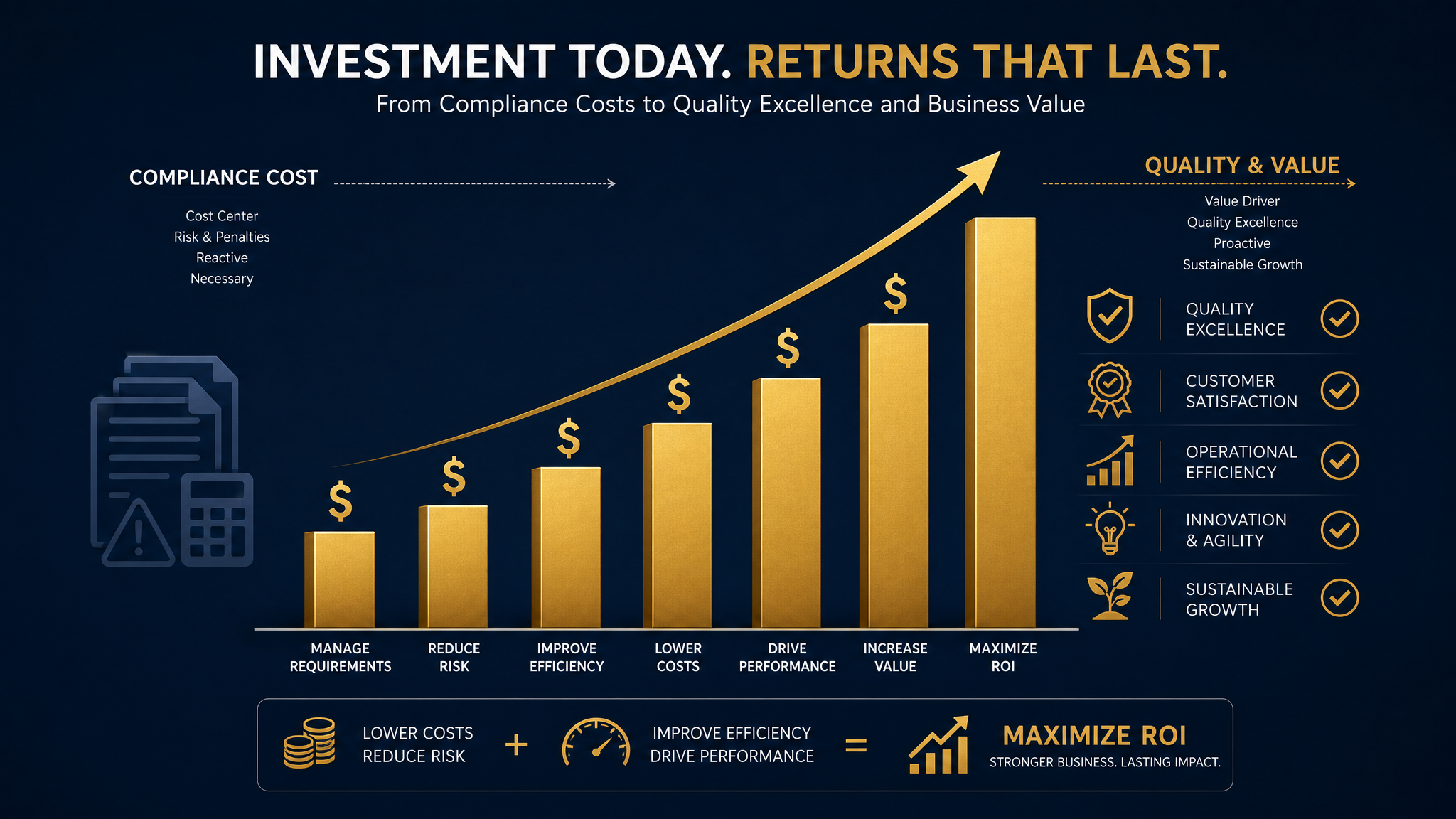
The goal is to shift spending from failure and appraisal toward prevention — where every dollar invested returns $10–50 in avoided failure costs.

Building Your QMS Software Business Case

To justify the investment in QMS software, quantify these specific savings:

Time Savings

Hours spent searching for documents × average hourly rate
Hours spent preparing management review data × frequency
Hours spent on manual CAPA tracking × average hourly rate
Hours spent chasing training record updates × average hourly rate

Risk Reduction

Cost of your last audit non-conformity × probability of recurrence
Average cost per customer complaint × current complaint rate
Cost of a product recall × estimated probability without QMS controls

Efficiency Gains

Reduction in document approval cycle time × number of documents per year
Reduction in CAPA closure time × number of CAPAs per year
Reduction in audit preparation time × number of audits per year

A Sample ROI Calculation

Consider a 200-person manufacturer with these current costs:

Document management labor: 20 hrs/week × $45/hr = $46,800/year
Audit preparation: 40 hrs × 4 audits × $55/hr = $8,800/year
CAPA tracking overhead: 10 hrs/week × $50/hr = $26,000/year
Training record management: 8 hrs/week × $40/hr = $16,640/year
Annual audit non-conformity remediation: $15,000/year
Customer complaint investigation: $25,000/year

Total annual cost: $138,240

With QMS software reducing these costs by 60–80%, the annual savings range from $82,944 to $110,592. Against a typical QMS software investment, the payback period is often under 6 months.

Beyond the Numbers

Some benefits resist easy quantification but are equally important:

Confidence during audits: — knowing your system is always ready
Faster customer onboarding: — demonstrating a mature quality system
Employee satisfaction: — quality professionals using modern tools, not fighting spreadsheets
Scalability: — a system that grows with your business without adding headcount

The question isn't whether you can afford QMS software. The question is whether you can afford not to have it.

See ExceleorQMS in Action

Experience how our platform automates compliance workflows, tracks CAPAs, and keeps you audit-ready — every day.
Related Standards